Sufi Shrines and Sacred Places of Kashmir
A respectful guide to Kashmir's Sufi shrines, temples, gurudwara and Buddhist sites, with festivals and visitor etiquette.
In Kashmir, tea is never just a drink. It is the first thing offered to a guest, the reason for a pause in a long day, the companion of every bakery breakfast and the warmth that carries families through winter. Two teas define the valley: kahwa, a fragrant green tea brewed with saffron and spices, and noon chai, a pink, salted milk tea that surprises almost every visitor. Both are traditionally made in the samovar, an engraved copper urn that sits at the heart of Kashmiri hospitality.
This guide explores Kashmir’s tea culture: the history of the samovar, how kahwa and noon chai are made, when and how Kashmiris drink tea, the breads that go with it, where to try it and how to make both at home.
The samovar arrived in Kashmir along trade routes from Central Asia. A Kashmiri samovar is usually made of copper, often beautifully engraved, with a central chimney filled with live coals and a surrounding chamber for tea. The coals keep the tea hot for hours, so a samovar can be carried to a picnic or kept bubbling on cold days. Older homes treasure heirloom samovars passed down for generations, and copper workshops in Srinagar’s old city still make them by hand.
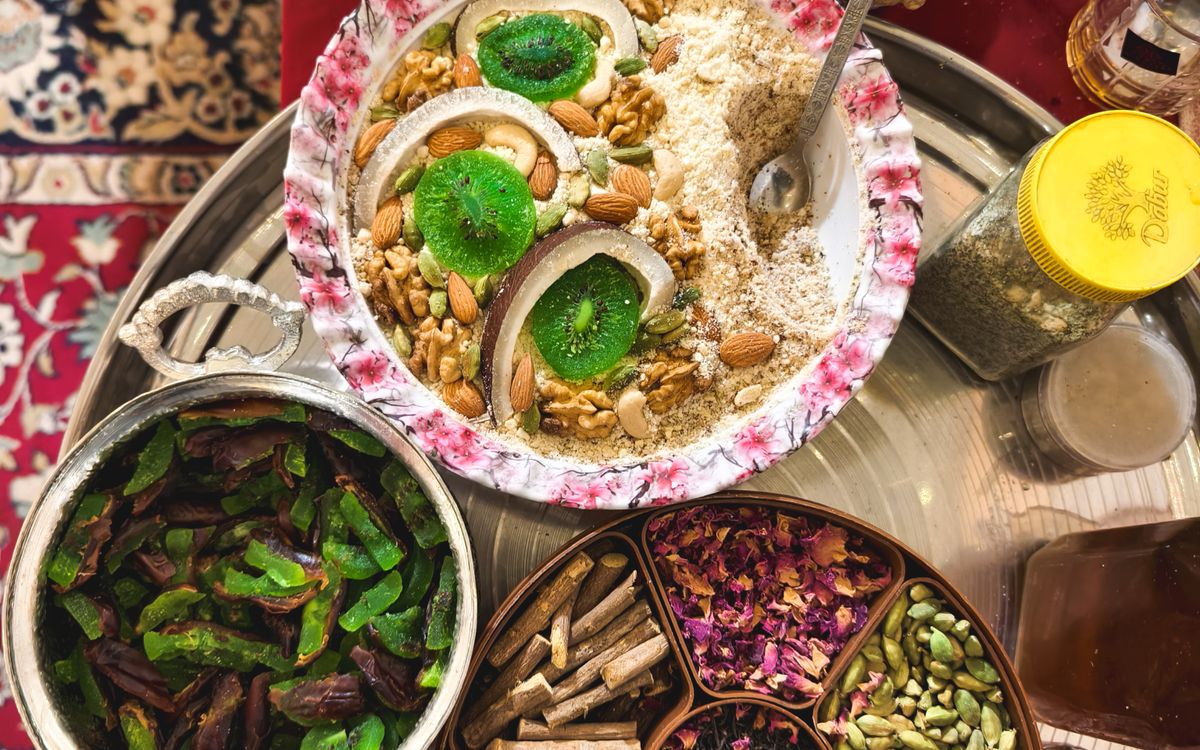
Kahwa (also spelled qehwa) is green tea brewed with saffron strands, cardamom, cinnamon and sometimes cloves, sweetened with sugar or honey and served with slivered almonds or walnuts. It is golden, fragrant and gently warming.

Noon chai (from noon, meaning salt) is Kashmir’s everyday tea, also called sheer chai or pink chai. It is made from a special green tea leaf boiled for a long time with a pinch of baking soda, which, with the addition of milk, gives it its striking pink colour. It is seasoned with salt rather than sugar, and often finished with cream or crushed nuts.
The taste is creamy and savoury, unusual at first but loved by many visitors once they try it with bread.
Kashmiri tea time is inseparable from the neighbourhood baker, the kandur, who bakes in a clay oven twice a day. Fresh breads include:
| Bread | Description |
|---|---|
| Girda | A round, soft, slightly chewy bread with finger marks pressed into the top; the classic breakfast bread |
| Lavasa | A thin, crisp flatbread, often eaten with butter |
| Tschot | A small round bread, often sprinkled with sesame or poppy seeds |
| Bakarkhani | A flaky, layered bread, slightly sweet, for special occasions |
| Kulcha | A crumbly, biscuit-like bread, sometimes with poppy seeds; great with noon chai |
| Sheermal | A soft, slightly sweet milk bread |
Kashmiris dip bread into their noon chai, and a morning walk to the bakery is a daily ritual in every neighbourhood.

To understand how central tea is, follow a typical day in a Kashmiri home. At dawn, someone walks to the neighbourhood baker for fresh girda or tschot. Breakfast is bread with butter and steaming cups of noon chai, poured from a samovar or a kettle kept on a low flame. Mid-morning, if a neighbour or relative drops by, out comes another round of tea, often kahwa this time, with biscuits. In the afternoon, around four, families gather again for noon chai with more bread from the baker’s second bake of the day. In winter, tea is drunk even more often, sometimes six or seven cups a day, to stay warm. And whenever a guest arrives, no matter the hour, the first question is always: “Chai?”
You can’t talk about Kashmiri tea without talking about the kandur, the neighbourhood baker. Every locality in Srinagar has at least one, usually a small shop with a deep clay oven (tandoor) sunk into the floor. Bakers start before dawn, slapping rounds of dough onto the hot walls of the oven and lifting them out with long iron hooks. By 6 am, a queue forms: children sent to buy the day’s bread, elderly men chatting, women in pherans with cloth bags. The bakers bake again in the late afternoon for evening tea.
Visiting a bakery early in the morning is one of the simplest, most authentic experiences in Srinagar. Buy a few fresh girda or tschot, still warm, and eat them with butter and noon chai at a nearby tea stall. Many bakers are happy to let you watch them work.
In older homes, the samovar is lit in the morning and kept going all day in winter, filled with kahwa or water for noon chai. Coals are carried from the kitchen fire and placed in the central tube; the surrounding chamber holds the tea, which stays hot for hours. Families sit around the samovar on cold evenings, and it’s carried outdoors for picnics in the meadows and gardens. Modern kettles and flasks have replaced the samovar in many households, but it remains a symbol of hospitality and is still brought out for guests and special occasions.
Tea isn’t just something to fit in; it’s an experience you’ll have naturally throughout your trip. But a few moments are worth planning: a bakery-and-noon-chai breakfast in the old city, kahwa on your houseboat deck at sunset, saffron kahwa at Pampore, and a cup of hot tea at a dhaba on a cold mountain road. Each one tells you something about Kashmir’s warmth.
Kahwa is a sweet green tea with saffron and spices, served without milk. Noon chai is a salted, pink milk tea.
Boiling the special tea leaves with baking soda creates a deep red concentrate, which turns pink when milk is added.
Yes, a small amount from the green tea leaves.
No, it is seasoned with salt, though some people add a little sugar.
In copperware shops in Srinagar’s old city and at handicraft emporiums.
Café “Kashmiri chai” outside Kashmir is often sweetened and flavoured differently. Traditional noon chai is salty.
Yes. Ask for one that is tin-lined inside for use; many decorative samovars are not meant for cooking.
Light, sweet and fragrant, with saffron, cardamom and cinnamon, and a gentle crunch from almonds.
Ask us to add a bakery-and-tea morning in Srinagar’s old city, a homestay visit or a saffron kahwa tasting at Pampore to your trip. It’s a simple, delicious way to feel Kashmiri hospitality.