Gurez Valley Travel Guide
How to visit Gurez: the Razdan Pass drive, permits, Habba Khatoon, Tulail Valley, local Shina culture, where to stay and when to go.
Most Kashmir itineraries race south from Srinagar along the highway to Pahalgam and back again. Yet on either side of that road lies a part of the valley few visitors ever see: a land of spring-fed Mughal gardens, ancient stone temples, roaring waterfalls, trout streams and quiet forest meadows. This is south Kashmir, and it is our home.
Our team is based in Bijbehara, in Anantnag district, and this guide is our personal introduction to the region. It covers the springs of Kokernag, Verinag and Achabal, the waterfall at Aharbal, the forest meadow of Daksum, the high pass at Sinthan Top, the ruins of Martand and Avantipora, and the small towns in between, with practical advice on when to go, where to stay and how to put it all together.
| Place | District | Known for | Time needed |
|---|---|---|---|
| Avantipora | Pulwama | 9th-century temple ruins | 45 minutes |
| Pampore | Pulwama | Saffron fields | 30 minutes (longer in harvest season) |
| Bijbehara | Anantnag | Chinar garden, riverside, cricket-bat workshops | 1 hour |
| Martand Sun Temple | Anantnag | 8th-century temple ruins on a plateau | 1 hour |
| Achabal | Anantnag | Mughal garden built around a spring | 1 hour |
| Kokernag | Anantnag | Botanical garden, springs, trout | 1.5 hours |
| Verinag | Anantnag | Octagonal Mughal spring, source of the Jhelum | 1 hour |
| Daksum | Anantnag | Forest meadow on the Bringi stream | Overnight |
| Sinthan Top | Anantnag | High mountain pass with snow into summer | Half day |
| Aharbal Waterfall | Kulgam | Waterfall on the Veshaw River | Half day or overnight |

The highway south from Srinagar passes three stops worth your time.
Pampore sits on a raised plateau (karewa) where Kashmir’s famous saffron is grown. In late October and early November the fields bloom purple at dawn and families pick the flowers by hand. Outside harvest season, stop at a saffron shop to learn how to recognise genuine Kashmiri saffron.
Avantipora has the ruins of two stone temples built in the ninth century by King Avantivarman, one dedicated to Vishnu and one to Shiva. The carved columns and gateways give a sense of the valley’s ancient architecture.
Bijbehara, our hometown, lies on the Jhelum. Its riverside chinar garden, often linked with the Mughal prince Dara Shikoh, has some of the oldest chinar trees in the valley. Along the highway you will also see stacks of willow clefts drying outside cricket-bat workshops; many of India’s cricket bats begin life here.
On a plateau near the town of Mattan stand the ruins of the Martand Sun Temple, built in the eighth century by King Lalitaditya Muktapida. Even in ruins, its scale is impressive: a colonnaded courtyard surrounds the central shrine, with views across the valley to the Pir Panjal. It is a protected monument; visit in the late afternoon when the stone glows in warm light.

South Kashmir is famous for its springs, which gush from the foot of the mountains, clear and cold. The Mughals built gardens around three of them.
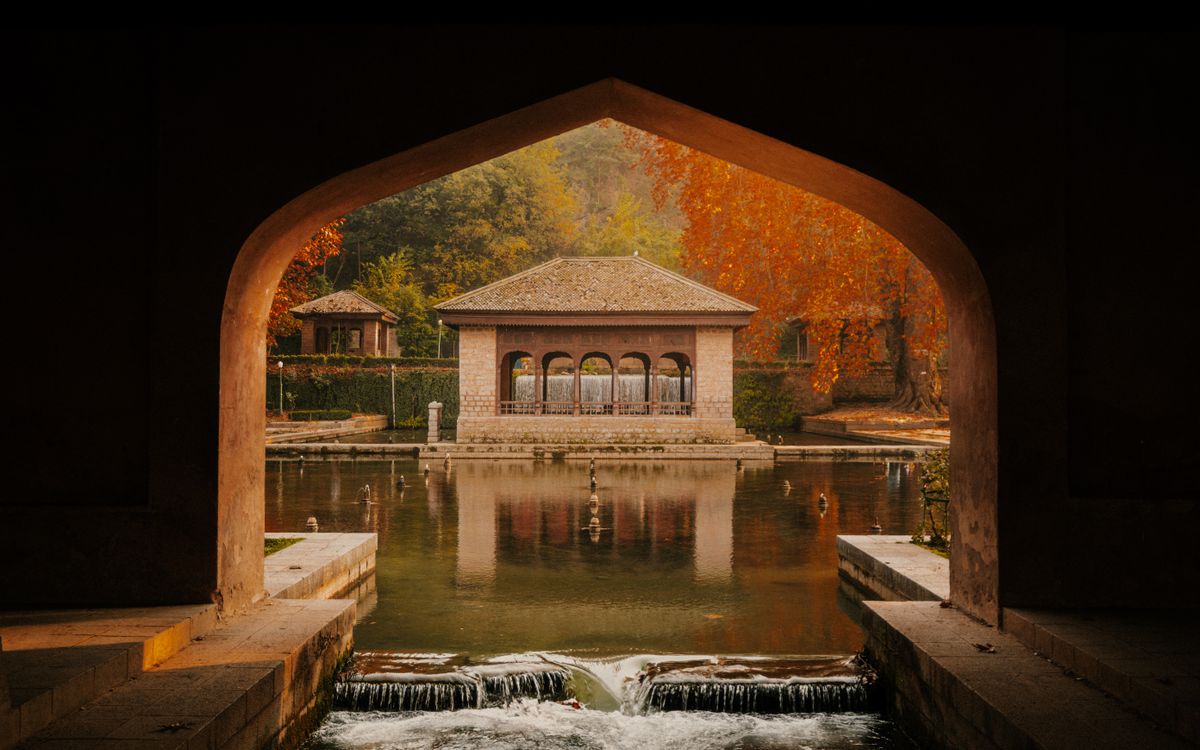
Achabal’s garden is laid out around a powerful spring at the foot of a forested hill. It is associated with Empress Nur Jahan in the seventeenth century, and water cascades down its terraces in channels and fountains. It is smaller and quieter than Srinagar’s gardens, with lovely old chinars.
Kokernag, about 70 kilometres from Srinagar, is known for its springs, said to have medicinal properties, which emerge in several streams from the hillside. Around them is a large botanical garden with lawns, flower beds and towering trees, and a trout farm nearby. It is a peaceful place for a picnic.
At Verinag, a deep blue spring fills an octagonal stone tank built by Emperor Jahangir, surrounded by arched niches. The spring is considered the source of the Jhelum river. Jahangir loved Kashmir so much that he is said to have wished to be buried here. It is one of the most atmospheric places in the valley, especially early in the morning.
Beyond Kokernag the road climbs through dense forest of fir and pine to Daksum, at about 2,400 metres. It is not a town but a quiet clearing on the banks of the Bringi stream, with a handful of tourist huts and a rest house. Daksum’s appeal is its stillness: the sound of water, the smell of pine and meadows where shepherds graze their flocks in summer.
Spend at least one night here. Walk along the stream, try trout fishing (with a permit from the fisheries department), or simply sit outside your hut and watch the light change on the forest. Facilities are basic, so bring warm clothes and a torch.
From Daksum, the road continues to climb in switchbacks to Sinthan Top, a pass at roughly 3,700 metres on the road to Kishtwar. Snow walls line the road well into early summer, and the top opens onto rolling slopes with sweeping views of the Pir Panjal and surrounding peaks. There are a few tea stalls but little else, which is exactly the point.
The road is usually open from around May or June until the first heavy snows of autumn. Check conditions locally before you go, carry warm layers even in July, and allow a half day for the round trip from Daksum.
In Kulgam district, the Veshaw River crashes through a narrow rocky gorge at Aharbal, forming one of Kashmir’s most dramatic waterfalls, often described as about 25 metres high. The surrounding pine forest and meadows make it a lovely place to spend a few hours. Viewing points let you get close to the spray; take care on wet rocks and keep children close.
Aharbal is also the starting point for the trek to Kounsarnag, a high-altitude lake in the Pir Panjal, and walks to the meadows of Kungwattan. There are tourist huts if you want to stay overnight. Aharbal is about 2 to 2.5 hours from Srinagar via Shopian, or can be reached from Yusmarg and Kulgam as part of a loop.
South Kashmir links naturally with two better-known destinations:
| Night | Stay | Highlights |
|---|---|---|
| 1–2 | Srinagar | Dal Lake, Mughal Gardens, old city |
| 3 | Yusmarg | Charar-e-Sharif, Nilnag Lake walk |
| 4 | Aharbal | Aharbal Waterfall, Kungwattan meadows |
| 5–6 | Daksum | Kokernag on the way, Sinthan Top day trip |
| 7–8 | Pahalgam | Achabal and Martand on the way, Aru and Betaab valleys |
This is the route of our Hidden Kashmir: Yusmarg, Aharbal & Daksum package.
South Kashmir’s cooking is home-style and seasonal. Trout from the cold streams around Kokernag and Daksum is a local favourite, usually fried with spices. Orchards around Shopian and Kulgam produce some of the valley’s best apples, and in autumn roadside stalls sell them by the crate. Ask your driver to stop at a local bakery for fresh tschot and girda with noon chai, and try nadru (lotus stem) and haak at a dhaba in Anantnag. In Pampore, a cup of saffron kahwa is a must.
Beyond its landscapes, south Kashmir is a working countryside. You may see families harvesting rice in September, picking apples in October, or gathering saffron flowers at dawn in November. Bijbehara’s willow-cricket-bat workshops are fascinating to visit. In villages, look out for traditional houses with wooden balconies and the stacks of firewood and hay stored for winter. A short walk through an orchard village with a local guide gives a glimpse of rural Kashmiri life that few visitors experience.
Anantnag is about 55 kilometres, roughly 1.5 hours by road. Kokernag is about 70 kilometres, and Daksum and Aharbal are around 2 to 2.5 hours away.
Yes. A loop through Pampore, Avantipora, Bijbehara, Martand, Achabal and Kokernag makes a full but rewarding day. Daksum, Sinthan Top and Aharbal are best with an overnight stay.
No. It is usually open from around May or June until the first heavy autumn snow. Check local road conditions before you go.
Government tourist huts and rest houses offer basic but comfortable rooms. They are limited, so book in advance.
Easily. Pahalgam lies just beyond Anantnag, so south Kashmir fits naturally on the way to or from Pahalgam.
Because we live here, south Kashmir is the part of the valley we love to show visitors most. Add a south Kashmir day to any package, choose our South Kashmir Springs & Gardens tour, or travel the full Hidden Kashmir route with Yusmarg, Aharbal and Daksum. We will introduce you to the places, and the people, that make this corner of the valley special.